Warehouse & logistics
Ride-on scrubbers, sweepers, and industrial vacuums help control dust, pallet debris, tire marks, and long-route productivity inside high-throughput buildings.
Different buildings create different cleaning physics. Soil type, surface texture, pedestrian flow, water access, noise limits, and hygiene expectations all change which Kärcher machine should be considered first.
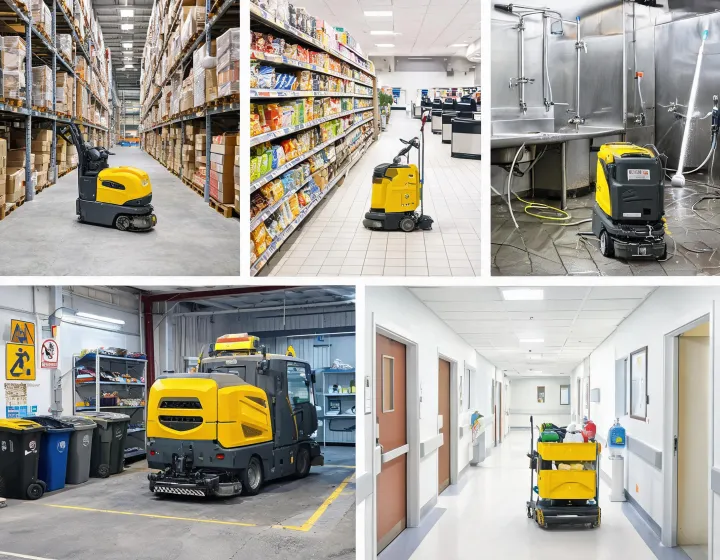
The right machine does more than remove visible soil. It helps a site protect walking surfaces, control dust, recover water, reduce manual rework, and keep cleaning windows predictable. That is why Kärcher recommendations begin with the industry setting instead of a universal product pitch. A supermarket, a cold storage warehouse, a school corridor, and a city maintenance garage may all need clean floors, yet the machine profile, consumable plan, and service routine can be completely different.
Ride-on scrubbers, sweepers, and industrial vacuums help control dust, pallet debris, tire marks, and long-route productivity inside high-throughput buildings.
Compact scrubbers and quiet operating modes support customer-facing cleaning where recovery, maneuverability, and short cleaning windows matter.
Pressure washers, wet vacuums, and floor cleaning routines must respect sanitation zones, drainage, water temperature, and controlled chemical handling.
Sweepers and pressure washers handle depots, transit areas, public works garages, sidewalks, and event cleanup with rugged service requirements.
Low-noise floor care, visible recovery, training consistency, and predictable maintenance support cleaning in occupied spaces.
Industrial vacuums, sweepers, and pressure cleaning support production dust, oils, metal chips, equipment wash-down, and shift change readiness.
Pressure washers and sweepers address grit, salt, tire residue, drainage areas, and exterior pedestrian surfaces exposed to weather.
Mixed fleets allow contractors and in-house teams to standardize consumables while still covering multiple surfaces and tenant expectations.
Industry matching becomes easier when the decision is reduced to observable constraints. A facility team should document floor type, debris profile, route length, available water, charging location, operator skill, and service access. Those facts help avoid under-sized equipment, unnecessary accessories, or machines that cannot be maintained within the site's schedule.
| Environment | Main constraint | Kärcher machine focus | Specification note |
|---|---|---|---|
| Warehouse | Long aisles and dry debris | Ride-on scrubbers and sweepers | Runtime, tank volume (often 60–120 L), turning radius, dust control |
| Food plant | Wash-down and hygiene zones | Pressure washers and wet vacuums | Hot water near 80°C, hose handling, drainage, filter care |
| Retail | Occupied cleaning windows | Compact scrubbers | Noise around 60 dB(A), recovery, maneuverability, visual finish |
| Municipal | Outdoor grit and varied sites | Sweepers and pressure washers | Rugged duty, accessories, transport, service access |
Equipment matching is rarely a clean answer; most sites face a real argument with valid positions on both sides. These are the trade-offs we work through openly rather than steering every buyer to the largest machine.
On dusty warehouse and yard floors, scrubbing without a sweeper pass clogs squeegees and recovery; but adding a sweeper stage is a second machine and second route. Light debris favours a single scrubber, heavy debris favours the two-step method.
Hot water clears grease and meets sanitation faster, yet costs more to buy and to run on fuel or power. Cold-water units are cheaper and lighter but slower on baked soil. Food and fleet bays usually justify heat; general exterior work often does not.
Battery frees the operator and suits occupied retail and healthcare floors, but adds charging logistics, runtime planning, and replacement cost. Cable removes runtime risk but limits range and adds a trip hazard. The split follows route length and charging access.
Standardising simplifies parts, training, and records; a mixed fleet can better fit specialised tasks and improve price leverage. Multi-site operators lean to standardisation, while highly varied sites may keep specialist machines.
A defensible recommendation also marks its own boundaries. These conditions usually call for a specialist machine, a process change, or manual work rather than a standard commercial cleaning unit:
Send the industry setting, floor area, surface type, soil profile, and cleaning window. A focused review can narrow the product family before a demo is scheduled.
Request Application Review